
A first-article inspection is the cheap gate that catches the boss that’s 0.3 mm too small to take the screw — while it’s one part on a bench, not 10,000 units on a pallet halfway across the Pacific. It is the difference between “the factory says it’s good” and “you proved it’s good,” and the gap between those two sentences is where launches quietly die. Skipping FAI to claw back a week of schedule is one of the most expensive trades in hardware: you save seven days now and lose six weeks re-tooling later.
What an FAI actually is
A first-article inspection is a full dimensional + functional + cosmetic check of the first parts off the real production process, measured against the released drawing, before you authorize mass production. Three words in that sentence carry all the weight.
- Production process. The part must come from the actual tool, the actual machine, the actual operator and cycle settings you will use at volume. A hand-finished engineering sample that someone spent two hours deburring under a loupe tells you nothing about what 10,000 untouched parts will look like.
- Released drawing. Not the STEP file, not last month’s PDF. The frozen, revision-controlled drawing with tolerances, GD&T, material callouts, and finish notes. If the drawing isn’t locked, the FAI has nothing to pass against.
- Before mass production. FAI is a gate, not a postmortem. It happens after tooling exists and before the green light, so a failure costs you a tool tweak, not a container of scrap.
It ties directly to the tool-sample sequence. T1 is the first shot off a new mold or the first run off a new fixture — expect it to be ugly: short shots, flash, dimensions drifting, witness marks. You measure T1, feed corrections back, the toolmaker reworks steel, and you get T2. Sometimes there’s a T3. FAI is the formal sign-off you run on the sample round that you intend to freeze — usually T2 or later — once the part is genuinely representative of production. T1 is a conversation; the FAI is the contract.
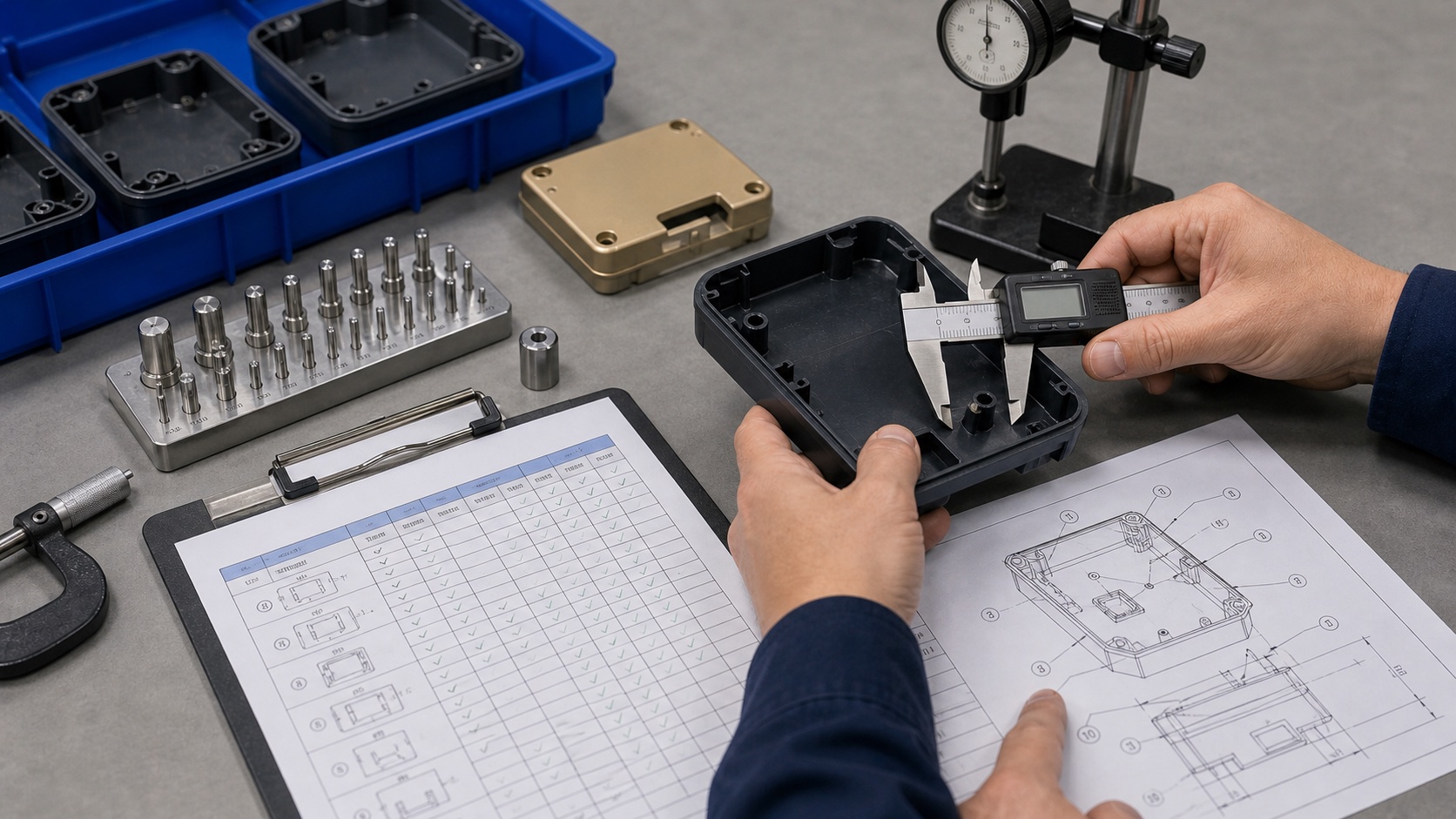
The ballooned drawing
You cannot inspect against prose. The backbone of a real FAI is a ballooned drawing: every dimension and callout on the print gets a numbered balloon, and that number maps to a row in the report. Each row carries four things at minimum:
- Nominal — the target value from the drawing.
- Tolerance — the allowed band, e.g. ±0.10 mm, or a GD&T zone.
- Measured — the actual value the inspector recorded (ideally several samples, not one).
- Pass/Fail — computed, not eyeballed.
The point of ballooning is traceability. When dimension #47 fails, nobody argues about which 6.20 mm boss they meant — balloon 47 on the drawing, row 47 in the table, one feature, no ambiguity. If a supplier sends you a “FAI” that is a paragraph saying “all dimensions within spec,” you have received a feeling, not a report. Send it back.
What to measure
You do not need to measure all 312 dimensions on a complex part with the same rigor — you need to measure the ones that matter, fully, and have a plan for the rest. Demand coverage of:
- Every critical dimension and GD&T callout. Anything that mates, seals, locates, or carries load: bore diameters, bolt-circle positions, flatness on a sealing face, true position on connector cutouts, wall thickness where it matters. These are typically flagged as critical-to-function (CTF) on the drawing; if your drawing doesn’t flag them, that’s the first fix.
- Material and certificates. The resin grade, the alloy, the plating spec, RoHS/REACH where required. A Certificate of Conformance and, for metals, a material/mill cert. “PC/ABS” on the drawing and a CoC for a different blend is a silent failure that surfaces as cracking three months in.
- Functional tests. The part has a job; test the job. Fit and assembly into mating parts, button travel and click force, snap-fit engagement, hinge cycles, IP seal / water ingress, electrical continuity and hipot, torque-to-fail on threaded features. Define each as a pass/fail with a number: “button travel 0.8–1.2 mm, actuation force 1.6±0.4 N,” not “button feels good.”
The measurement method and gage R&R
How a number was captured is part of the data. A measurement you can’t trust is not a measurement — it’s a rumor with a decimal point. The report should state the instrument and method for each dimension class:
- Calipers (~±0.02 mm operator-dependent) are fine for coarse lengths, useless for a ±0.01 mm bore or anything positional.
- Micrometers / pin & ring gages for tight diameters and bores.
- CMM (coordinate-measuring machine, ~±0.002–0.005 mm) for true position, profile, and anything with GD&T datums. If your drawing has GD&T and the report was done with hand calipers, the GD&T rows are fiction.
- Optical comparator / vision system for 2D profiles and small features; CT scan for internal geometry and wall thickness you can’t reach.
Then there’s repeatability. A useful rule: your measurement system should consume less than 10–20% of the tolerance band (the “10:1” or at least “4:1” gage rule). If the feature tolerance is ±0.05 mm (0.10 mm band) and your gage’s own variation is 0.04 mm, you literally cannot tell a good part from a bad one. For anything critical, ask whether a gage R&R (repeatability & reproducibility) study was run — same part measured by multiple operators multiple times. A gage R&R under 10% is excellent; 10–30% is marginal-but-usable; over 30% means the gage is the problem and your “data” is noise.
Process capability and Cpk
One part being in tolerance tells you that part got lucky. Cpk tells you whether the process will keep landing in tolerance over a full run. It measures how many standard deviations of breathing room sit between your process mean and the nearer spec limit:
Cpk = min(USL−μ, μ−LSL) / 3σ ≥ 1.33
where USL/LSL are the upper/lower spec limits, μ is the measured mean, and σ is the process standard deviation. The target of 1.33 means the nearer spec limit is 4σ away — so normal process scatter stays inside the band with margin, not by coincidence. Cpk = 1.0 (3σ) is living on the edge; about 0.27% of parts fall out, and any drift pushes you over a cliff. Below 1.0 you are shipping scrap on purpose. For a handful of FAI samples you can’t compute a rock-solid Cpk, but you should demand it for critical dimensions from a capability run (typically 30+ consecutive parts) before high volume. A dimension that’s nominally centered but riding the tolerance edge with a Cpk of 0.8 is a recall scheduled for next quarter.
Worked example: a ballooned-dimension excerpt
Here’s a representative slice of a real FAI table for a molded enclosure — five rows, including one that’s borderline and one that fails:
| Dim # | Feature | Nominal | Tolerance | Measured | Method | Pass/Fail |
|---|---|---|---|---|---|---|
| 12 | Overall height | 40.00 mm | ±0.20 | 40.06 mm | Calipers | Pass |
| 27 | Boss Ø (screw) | 2.40 mm | +0.05 /−0.00 | 2.42 mm | Pin gage | Pass |
| 34 | Seal-face flatness | 0 | 0.05 (GD&T) | 0.047 mm | CMM | Pass (borderline) |
| 41 | USB cutout true pos. | 0 | ∅0.20 (GD&T) | ∅0.31 mm | CMM | FAIL |
| 53 | Wall thickness | 2.00 mm | ±0.15 | 1.78 mm | CT scan | Pass |
Read what this table is telling you. Dim #41 is a hard fail: the USB cutout sits 0.31 mm off true position against a 0.20 mm zone, so the connector won’t seat squarely — that’s a tool correction, full stop. Dim #34 “passes” at 0.047 against a 0.05 limit, but with only 0.003 mm to spare on a sealing face, the honest reaction is not relief — it’s to ask for the Cpk. If that flatness comes off the line at μ = 0.040 with σ = 0.006, then Cpk = (0.050−0.040) / (3×0.006) = 0.010 / 0.018 ≈ 0.56. That is a leaking seal in a meaningful fraction of units; “Pass” on one sample masked a process that isn’t capable. The single most useful habit in reading an FAI is treating every borderline pass as a question, not an answer.
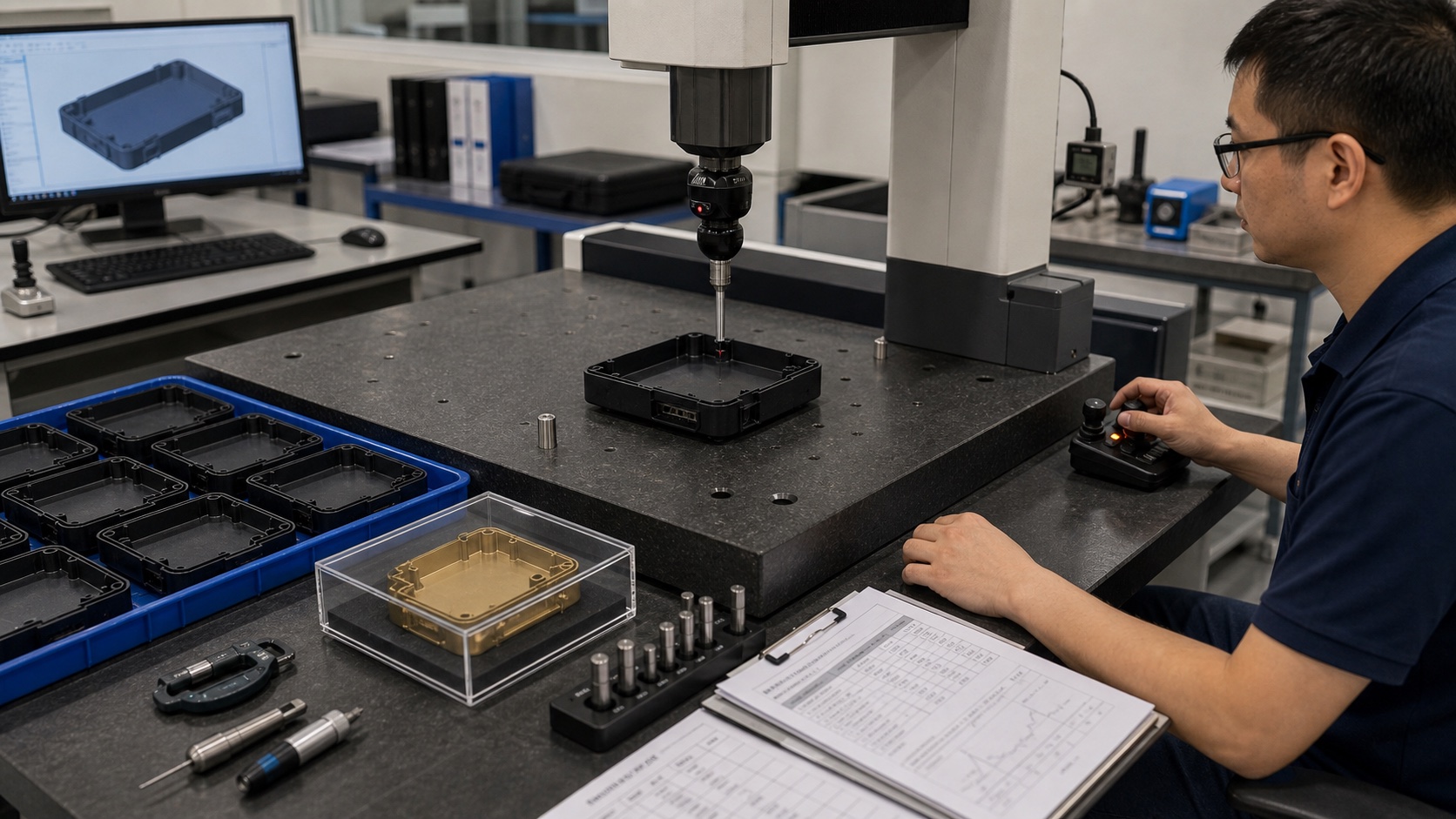
Golden samples
Numbers cover everything you can quantify. For everything you can’t — the exact texture of a finish, an acceptable amount of gloss, the feel of a detent, the precise color of a painted bezel — you need a physical reference. A golden sample is a part you and the factory have both physically inspected, agreed is correct, and signed and dated. Make at least two or three: one stays with the factory, one stays with you, one rides with QC. They become the tie-breaker for every “is this good enough?” argument at 2 a.m. during the production run. Without one, “matches the approved sample” means “matches whatever the line lead remembers,” which is to say nothing.
For color specifically, back the golden sample with an objective spec — a Pantone reference and a ΔE tolerance (ΔE ≤ 1.5–2.0 is typical for visible-match parts) — because plastic and paint drift batch to batch and “close enough” reads differently under warehouse fluorescents than under your office daylight.
Cosmetic AQL
Cosmetics are where launches get bogged down in religious wars, because “scratch” is not a yes/no — it’s a question of size, location, and how many. You settle this before production with a written cosmetic standard plus an AQL (Acceptable Quality Limit) sampling plan. The standard defines:
- Zones. Zone A (the face the user stares at), Zone B (sides, peripheral), Zone C (hidden/internal) — with progressively looser rules outward.
- Defect limits per zone. Max scratch length, max sink-mark depth/visibility, allowed dot count, allowed flow lines — often specified by viewing distance and time (e.g. “not visible at 30 cm under 500 lux within 5 seconds”).
- The sampling plan. An AQL level (commonly 0.65 for critical, 1.5 / 2.5 for major, 4.0 for minor cosmetic, per ISO 2859) sets how many units you pull from a lot and how many defects flip the whole lot to reject.
AQL is statistics, not vibes: a 2.5 AQL on a 3,200-unit lot means you inspect 125 units and reject the lot at 8 defectives. Agree the numbers up front, or you’ll be relitigating every scratch against a moving standard for the life of the product.
Who signs, and when
The FAI is signed after the representative tool sample round (T2 or later, never the hand-tuned T1) and before the mass-production green light — that timing is the entire point of the exercise. Three parties typically have to sign:
- The supplier’s QC records and certifies the measurements.
- Your engineering / quality owner reviews the data, the methods, and the borderline rows, and accepts or rejects.
- The program owner (you) gives the documented go/no-go that releases volume.
No signature, no PO release for mass production. The sign-off is the moment risk transfers from “unknown” to “accepted on the record,” and you want a name and a date on it, because the alternative is finding out who approved the bad cutout after the recall.
What “pass” actually means
“Pass” is not “looks fine.” A real pass is the conjunction of three independent gates, all of which must be true:
- Every critical dimension is in tolerance — with capability (Cpk ≥ 1.33) on the ones that matter, not a single lucky sample sitting on the line.
- Every functional test passes against a stated numeric criterion — fit, travel, force, seal, electrical.
- Cosmetics meet the golden sample and the AQL at the agreed sampling level.
Fail any one and the part fails, regardless of how good the other two look. A beautifully molded enclosure with a 0.31 mm cutout error is a fail. A dimensionally perfect part that leaks at the seal is a fail. “AND,” not “mostly.”
Common mistakes and failure modes
- Skipping FAI to save schedule. The classic. You recover a week and gamble the tool. When 10,000 parts come back wrong, the rework dwarfs anything you saved.
- Accepting “looks fine” with no report. A verbal “all good” from the factory is not a record and not leverage. If it isn’t written and signed, it didn’t happen.
- No ballooned drawing. Without numbered features you can’t trace a failure to a dimension, and every disagreement becomes an argument about which feature you meant.
- Not asking how it was measured. Calipers reported on a GD&T true-position callout is a fabricated number. Always demand the method and, for critical features, the gage R&R.
- No golden sample. Every cosmetic and tactile judgment then floats with no anchor, and “matches the approved part” becomes meaningless.
- Running FAI on a hand-tuned engineering sample. A part someone polished by hand is not what the process makes. You validated a one-off and green-lit a process you never checked.
- Ignoring cosmetic AQL. No written standard and sampling plan means you relitigate every scratch mid-run against a standard that drifts to whatever ships fastest.
- Treating borderline as pass. A dimension 0.003 mm inside the limit with a Cpk of 0.56 is a failure wearing a “Pass” badge.
The FAI report checklist: what to demand before you sign
| # | The report must contain… |
|---|---|
| 1 | Part number and the exact drawing revision it was inspected against (released, frozen). |
| 2 | The ballooned drawing, every dimension and GD&T callout numbered. |
| 3 | A row per balloon: nominal, tolerance, measured value(s), pass/fail — computed, not asserted. |
| 4 | Measurement method per feature (calipers / micrometer / pin gage / CMM / vision / CT) and instrument IDs. |
| 5 | Gage R&R (or stated measurement uncertainty) for critical dimensions; gage resolution ≤ 1/10 of tolerance. |
| 6 | Cpk for critical-to-function dimensions, target ≥ 1.33, with the capability sample size noted. |
| 7 | Functional test results with numeric pass/fail criteria (fit, travel, force, seal/IP, electrical). |
| 8 | Material & finish certs — CoC, mill/resin cert, plating spec, RoHS/REACH as required. |
| 9 | Cosmetic results against the written standard and AQL level, by zone, with the sampling plan stated. |
| 10 | Reference to the signed golden sample (and color ΔE spec where relevant). |
| 11 | The tool-sample stage the parts came from (T1/T2/T3) and confirmation they are production-process, not hand-finished. |
| 12 | Clear disposition and sign-offs — supplier QC, your engineering, program owner — with names and dates, plus a list of any open deviations. |
If a line on that list is blank, the FAI is incomplete — treat the blank as a fail until it’s filled, not as a detail to sort out after volume starts.
FAI is the gate where you stop trusting and start verifying: a real “pass” is every critical dimension in tolerance with margin, every function tested to a number, and cosmetics matched to a signed golden sample — on a production-process part, in writing, before you release volume.